Quick answer
In conventional single-row cylindrical roller designs, NU permits relative axial movement in both directions, while NJ locates in one direction and can carry limited axial load under the manufacturer’s conditions. The NU204R and NJ204R reference examples share 20 × 47 × 14 mm dimensions, but size alone does not establish interchangeability.
NU and NJ bearings can share a dimensional envelope while performing different jobs in a shaft assembly. For a buyer, the important distinction is not simply the number after the prefix: it is whether the arrangement must permit axial movement or provide location in a particular direction.
What is the difference between NU and NJ bearings?
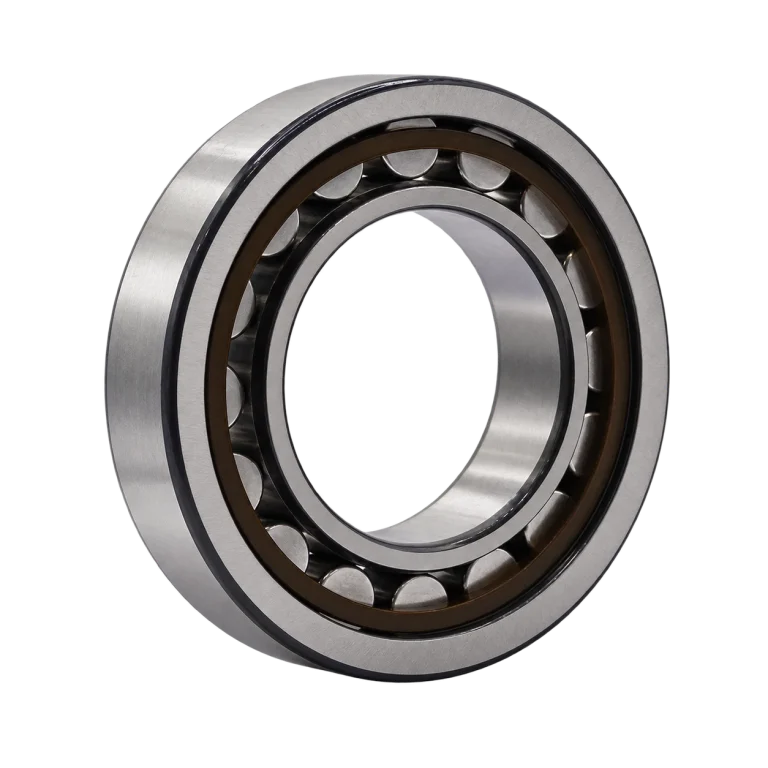
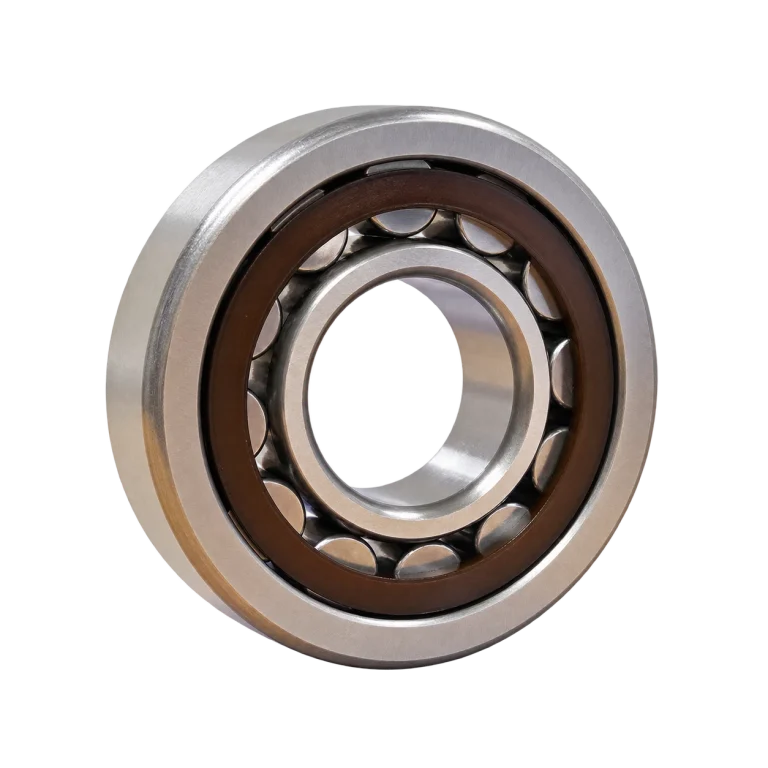
In the conventional single-row designs considered here, an NU bearing has two ribs on the outer ring and none on the inner ring. An NJ bearing has two outer-ring ribs and one inner-ring rib. NU permits relative axial displacement in both directions within its design limits; NJ provides axial location in one direction and can accommodate limited axial load under the manufacturer’s conditions.
These distinctions are described in NSK’s cylindrical roller bearing overview and its roller bearing types and characteristics guide. The permitted movement and axial duty still require the data for the exact design.
| Selection point | NU | NJ |
|---|---|---|
| Outer-ring ribs | Two | Two |
| Inner-ring ribs | None | One |
| Axial function | Relative displacement in both directions | Location in one direction |
| Buying question | How much movement must the support allow? | Which direction must the support locate? |
NU204 versus NJ204: why matching dimensions is insufficient
The JTEKT / Koyo NU204R and NJ204R reference records both specify 20 mm bore × 47 mm outside diameter × 14 mm width. The dimensional match does not remove the difference in rib arrangement or prove that the shaft support can be changed without review.
Our NU204 model page identifies NU204R as its technical reference, while the NJ204 model page identifies NJ204R. Keep those complete source designations attached to their data. The records are reference examples, rather than an assertion that all NU204 or NJ204 variants have identical internal design or SANJ performance.
How should buyers describe the shaft-support requirement?
Request an assembly drawing that shows both supports, shoulders, retention features and the position of the bearing. Mark the direction in which location is needed and the movement the design intends to permit. Record whether the enquiry concerns an unchanged replacement or a proposed redesign.
If operating temperature changes are relevant to the shaft arrangement, give the expected range and the engineer’s required movement allowance. Ask the supplier to confirm the permissible displacement of the proposed bearing and the associated installation conditions. Do not derive an allowable movement from a generic product photograph.
A complete review also needs the radial load, any axial load, speed, lubrication and duty cycle. An NJ designation does not provide a numerical axial capacity on its own. The supplier’s acceptance should refer to the full designation and the stated operating case.
What belongs in an NU or NJ purchase specification?
- Identity: full existing designation, drawing number and revision, bearing position, and the required boundary dimensions.
- Axial function: intended direction of location, required relative movement and the opposite-support arrangement.
- Configuration: material, cage, internal clearance, accuracy, lubrication and any special suffix or manufacturer requirement.
- Duty: radial and axial load information, speed range, temperatures, operating duration and relevant environmental conditions.
- Commercial scope: quantity, destination, packing, documentation and the process for approving deviations.
When comparing quotations, separate confirmed requirements from open engineering questions. Keep a proposed change of prefix visible on the comparison sheet; it should not disappear inside a statement that the sizes are equivalent.
Common NU versus NJ questions
Can I replace NU204 with NJ204?
Do not approve the change from dimensions alone. Review the axial function, bearing orientation, required movement and complete assembly with the responsible engineer.
Does an NJ bearing locate a shaft in both directions?
The conventional single-row NJ design considered here locates in one direction. Do not assume it provides the function of a different locating arrangement or a design with additional components.
Can a product photo confirm the rib arrangement?
A catalog reference photograph may be shared across models or show an angle that hides important features. Use the manufacturer’s drawing and full designation for approval.
Take the comparison into the enquiry
Browse cylindrical roller bearing models and compare the two identified source records. Use the bearing RFQ checklist, then send SANJ the drawing and axial-function requirement. Confirm the final configuration through the quotation and approved datasheet.