Quick answer
The cited 6205 and 7205 bearings both measure 25 × 52 × 15 mm, but 6205 is a deep groove ball bearing and 7205 is an angular contact ball bearing. They are not automatically interchangeable: load direction, contact angle, pairing and the complete shaft arrangement must be reviewed.
A bearing replacement can pass a size check and still change how a shaft is supported. The 6205 and 7205 are a useful example: their reference boundary dimensions match, while their bearing families and arrangement requirements differ. A purchasing decision therefore needs more than three measurements.
Do 6205 and 7205 have the same dimensions?
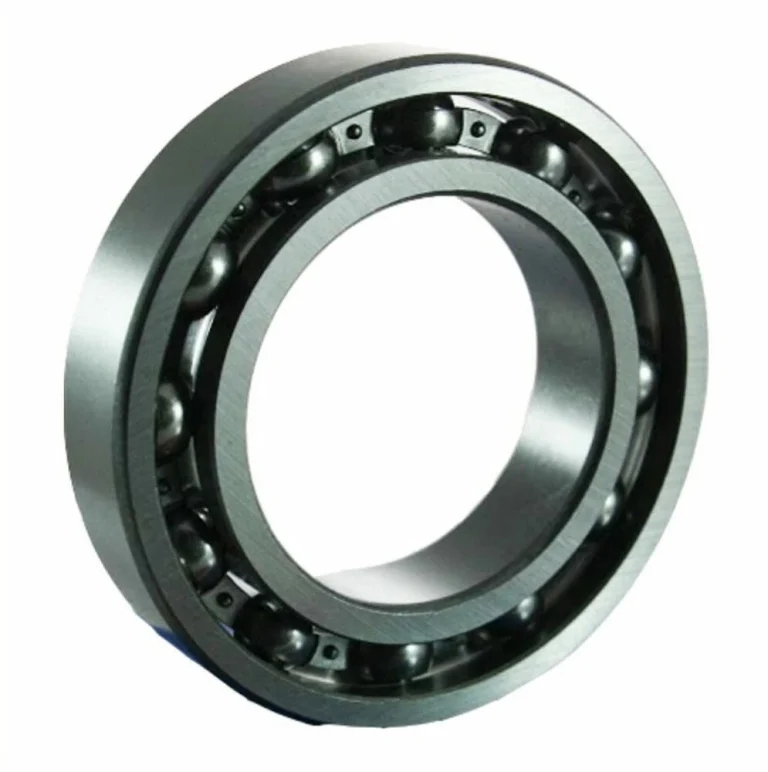
Yes. The named JTEKT / Koyo 6205 and 7205 records both give 25 × 52 × 15 mm for bore, outside diameter and width. The 6205 is a single-row deep groove ball bearing; the 7205 is a single-row angular contact ball bearing.
| Reference item | 6205 | 7205 |
|---|---|---|
| Bearing family | Deep groove ball | Angular contact ball |
| Bore d | 25 mm | 25 mm |
| Outside diameter D | 52 mm | 52 mm |
| Width B | 15 mm | 15 mm |
| Dynamic load rating Cr | 17.5 kN | 20.2 kN |
| Static load rating C0r | 7.85 kN | 10.3 kN |
Source records: JTEKT 6205 and JTEKT 7205. These ratings belong to those source configurations. They are not SANJ-approved ratings, a life calculation, or proof that the model with the larger number is the better replacement.
What changes in the load-support arrangement?
JTEKT describes deep groove ball bearings as accommodating radial load together with a degree of axial load in either direction. Angular contact bearings use a contact angle to support combined radial and axial loading. A conventional single-row angular contact bearing supports axial load in one direction, so the complete arrangement matters when thrust reverses.
See the manufacturer’s deep groove family description and angular contact family description. For single-row axial direction and paired arrangements, consult SKF’s angular contact bearing guidance. Apply the designation and engineering data of the actual proposed manufacturer.
Why do the contact angle and pairing need confirmation?
The 25 × 52 × 15 mm envelope does not specify contact angle, preload, matching or orientation. Do not add an assumed angle to a purchase order just because a reference photograph looks familiar. Ask for the full designation and the supplier’s drawing, then record the approved arrangement with the equipment documentation.
For an existing assembly, identify the bearing at the opposite support as well as the one being replaced. A photograph of one loose bearing does not show the direction of thrust, the locating arrangement or how the assembly is adjusted. If a paired arrangement is required, state that requirement explicitly rather than ordering two unspecified individual bearings.
What should be reviewed before a 6205-to-7205 substitution?
- Confirm the original function. Identify the equipment drawing, bearing positions and directions of radial and axial loading.
- Describe the operating duty. Include load values or a duty description, normal and maximum speed, starts and stops, temperature and lubrication.
- Document the assembly. Supply shaft and housing details, the opposite support, retention method and any specified adjustment or preload.
- Compare complete proposals. Review full designations, dimensional tolerances, closure, cage, clearance or preload, and the proposed manufacturer’s data.
- Record approval. Update the drawing or maintenance specification before treating a different family as an accepted replacement.
A quote that only repeats the three boundary dimensions leaves these questions unresolved. Ask the supplier to identify every deviation from the original requirement so that purchasing and engineering are comparing the same configuration.
Common 6205 versus 7205 questions
Can a 7205 replace a 6205 because the size is the same?
Not on the basis of size alone. The bearing family, load direction and assembly requirements must be reviewed and approved for the equipment.
Does the higher reference load rating make 7205 automatically better?
No. A rating is one input associated with a defined bearing design. It does not establish suitability for a different load direction, arrangement, lubrication or duty.
Which model should I put on an enquiry?
Use the existing complete designation and drawing where available. If the design is still open, describe the application and identify both candidates as options to review, rather than approving a substitution in advance.
Compare the model records
Open the 6205 specification and 7205 specification alongside each other. Explore angular contact ball bearings or send SANJ an application-based enquiry with the current drawing, quantity and operating brief.